By Walter Rutledge
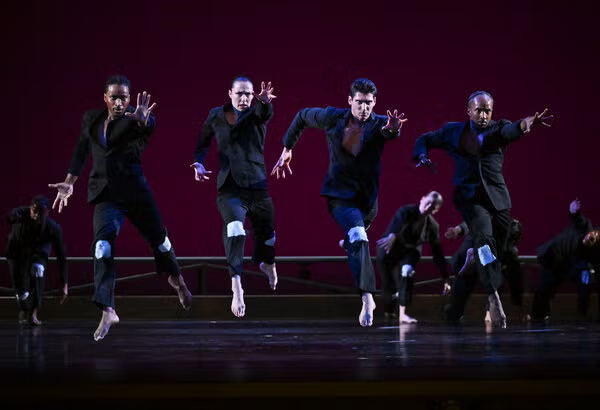
Its Taylor time! The Paul Taylor Dance Company begins its third and final week at New York State Theater. The company will present their last seven performances beginning today, Tuesday November 17 and run through Sunday November 22. The season has offered a varied and diverse look into the world of Taylor; presenting ten works by Taylor, a Murray Louis revival, world premiere by resident choreographer Lauren Lovette, a New York premiere by Pam Tanowitz and three works by resident choreographer Robert Battle.
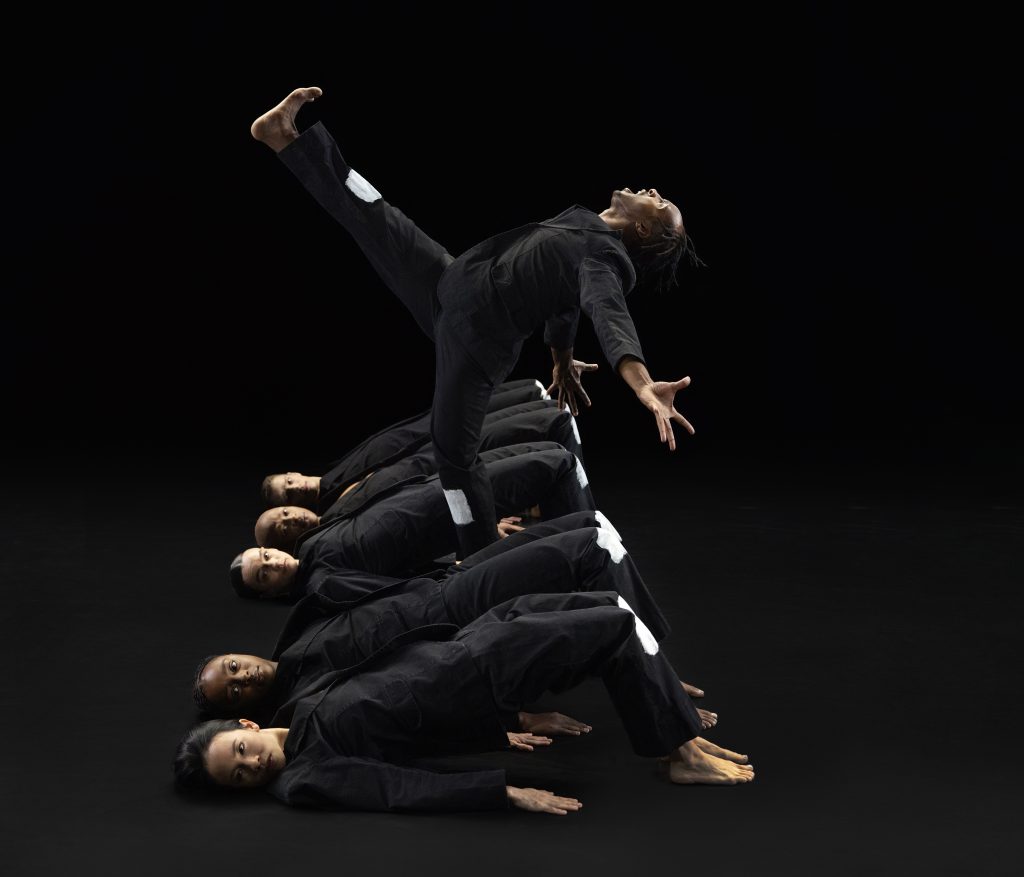
Battle’s much anticipated revival of his 2007 political dance manifesto No Longer Silent made its company debut on opening night, November 3. The statement piece recalled early 20th century protest works by Martha Graham, Kurt Jooss and Taylor. The work and Battle seemed to have found a new home with the Paul Taylor Dance Company.
Battle’s No Longer Silent is set to Ogelala (“Ballettmysterium”), Op. 53 by Austrian Czech Jewish composer Erwin Schuloff. Schulhoff composed the percussive orchestral score between 1922 and 1925 (Adolph Hitler released Volume One – Eine Abrechnung of Mein Kampf in 1925). Banned by the Nazi regime as “degenerate art,” Schulhoff died in 1942 of tuberculosis while imprisoned in the Wülzburg concentration camp.
At its premiere, the work received a favorable review by New York Times dance critic Rosalie O’Connor. She wrote, “he kept his stage society compellingly and always mysteriously.” But her next statement was part observation and premonition, “I immediately imagined the Alvin Ailey company, for which Mr. Battle already choreographs, staging this to great effect.” Little did she know the work would make its Ailey debut in 2015 to commemorate the 70th anniversary of the liberation of the Nazi concentration camps.
Schulhoff’s score was strongly influenced by Russian composer Igor Stravinsky and Hungarian Bela Bartok’s dramatic modernism. Like Stravinsky’s The Rite of Spring, the score relies heavily on percussive force and raw energy. The use of Central European expressionism, driving rhythmic ostinatos, jazz syncopations, and imagined Indigenous battle cries encompassed many of Battle’s signature music preferences.
Battle immediately established his choreographic prowess as sixteen performers entered in waves of four from stage right. The quartets introduced different rhythms and time signatures and evolved into two groups, turned into one line, then continued to seamlessly reconfigure. The works ever-shifting mechanical cadence created contrasting themes of individualism juxtaposed to social conformity. Nicole Pearce’s lighting produced a stark atmospheric environment; which balanced the music dissonant tone and the movement’s oftentimes austere quality. The works brave used stillness felt more like suspended action than stagnant tableaus.
One noteworthy theatrical moment was a slash of light that captured just the faces of the frozen huddled ensemble, as if caught in a searchlight. They remained motionless. When used effectively protracted lengths of stillness can be an extremely strong device to build tension. People came to see dance; now they are not moving… and they are still not moving! When are they going to move? On this occasion the stillness created an energy that was pure dance theater.
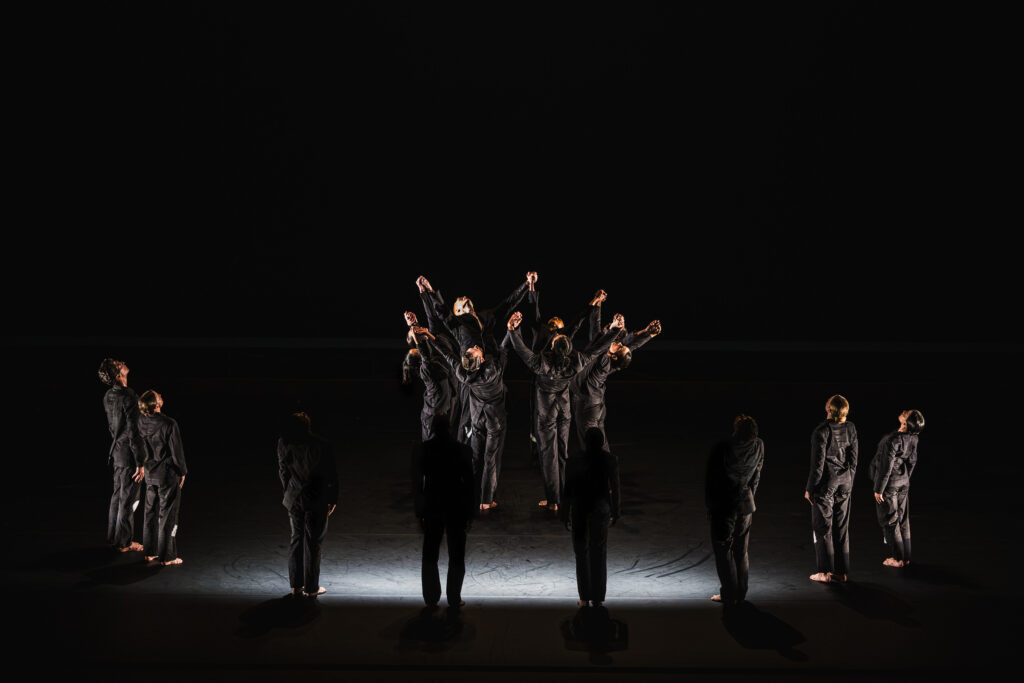
The compelling imagery throughout the work reinforced the narrative’s consistent and evolving pathos. Battle would sequester a solo dancer or duet couple in a down pool of light while the ensemble remained motionless as passive observers. These encapsulated movement biographies collectively recalled Pastor Martin Niemöller’s confession/speech First They Came. That ominous statement begins: “First they came for the Communists And I did not speak out. Because I was not a Communist…” With mouths open and arms reached upward the ensemble moved forward lockstep in a tight formation as the descending curtain seemed to visually cut off their escape route. Talking about a dramatic finale!
Art is supposed to raise your consciousness. It should send a message and extract a reaction. Dance does not have to be just saccharine or decorative, on rare occasions it makes a statement/declaration that, in time, may go out of fashion; but never goes out of style. In our present political climate No Longer Silent seems to reflect on the cyclical nature of history and how easy it is to repeat the past.
To hear Robert Battle Discuss No Longer Silent click below
10/28/26 O&A NYC BY WALTER RUTLEDGE: A Conversation With Robert Battle (Part One)- No Longer Silent
For information and to purchase tickets visit: https://paultaylordance.org/performances/newyorkseason/