6/12/26 O&A NYC DANCE BY WALTER RUTLEDGE: DanceAfrica 2026 Uganda: Umoja/Mirembe/Obulungi (Unity/Peace/Beauty)!

By Walter Rutledge

Memorial Day weekend, the Brooklyn Academy of Music, and an African market have all become synonymous with DanceAfrica; America’s largest celebration of African’s diasporic achievements in dance, music, art, theatre, fashion, craft, culture, and cuisine. The 2026 “Afrofest” faced challenges from Oya the Yoruba Orisha of storms, wind, and rain whose presence was felt the entire extended holiday weekend.

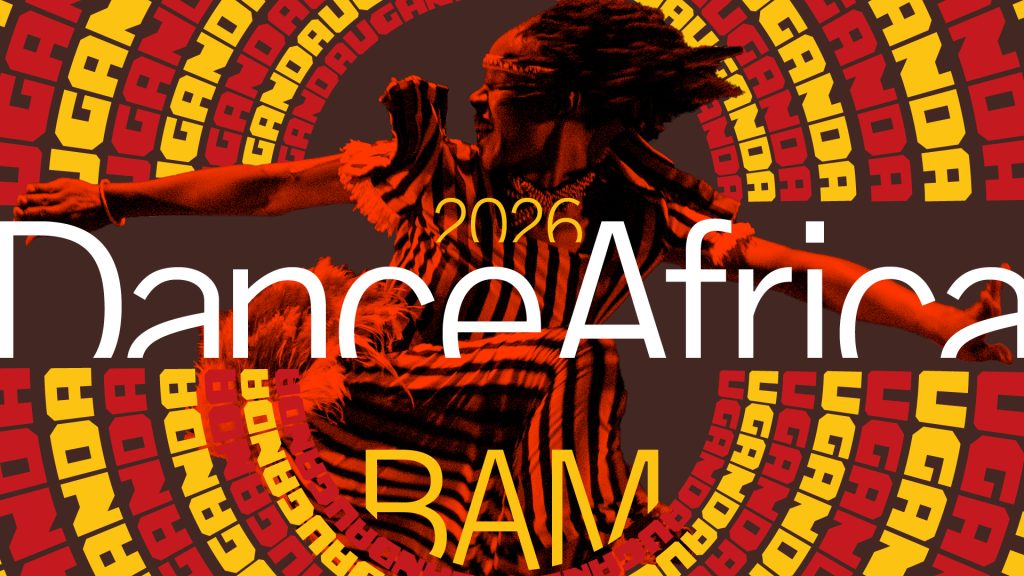
Even Oya’s inclemency could not dampen the enthusiasm and excitement for the annual dance concert, the centerpiece of the festival. This year’s theme was DanceAfrica 2026 Uganda: Umoja/Mirembe/Obulungi (Unity/Peace/Beauty)! The production was a stunning music and movement history lesson that continues to debunk the monolith myth.

When we refer to the monolith myth, we are referencing the misconception that the “country” of Africa exists in lockstep. To the contrary the African continent constitutes fifty-four sovereign nations with a multiplicity of languages, cultures, and customs. Over the festival’s forty-nine-year history DanceAfrica has strived to present the artistry from the entire African Diaspora including the Caribbean, South America and Bedford-Stuyvesant.
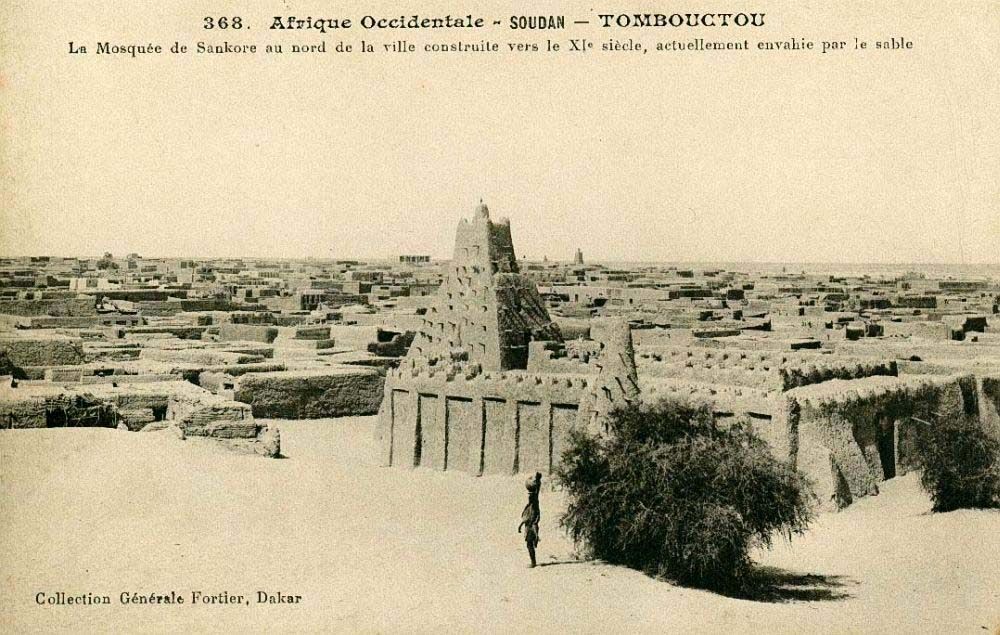
Long before the University of Bologna was established in 1088 AD Africa already had revered centers of learning. These included Morocco’s University of Al-Qarawiyyin (859 AD) and Egypt’s Al-Azhar University (970 AD). In the 14th-century Mali Empire ruler Mansa Musa established the fabled Sankoré Madrasa in Timbuktu, which rivaled Oxford and Cambridge. In many ways this four-day inner city immersive pedagogical experience embodies that spirit. Dance, music and visual arts workshops, seminars, community friendly events; and an abundance of outdoor food and craft vendors, and street performances (some spontaneous) all help create an entertaining, informative, and aspirational old world campus environment – a Brooklyn Sankoré Madrasa.   

The crown jewel is the dance celebration under the direction of DanceAfrica Artistic Director Abdel Salaam, respectfully referred to as Baba Abdel. We are calling this event a celebration instead of performance because many of the elements were/are ceremonial steeped in ritual, which predates western presentational entertainment. Nana Kofi Osei Williams offered the Libation; the Ghanaian tradition of pouring libation is a profound spiritual ritual used to ask for blessings and protection. An act of reverence, humility and gratitude it honors God, our ancestral spirits, and natural forces around us.   

The Prologue/Procession section began with a single drummer, Rasaan-Elijah “Talu” Green. The solo soon became a percussive quartet when joined by Nyemba Seales, Fara Camara and Jason McCaleb. Dr. Hanan Hameen-Diagne and four other members of the Memorial Candle Bearers move down the aisle to the space in front of the stage. Each dancer carried two candles and the joyous energy was an appropriate introduction for the procession of the Council of Elders.
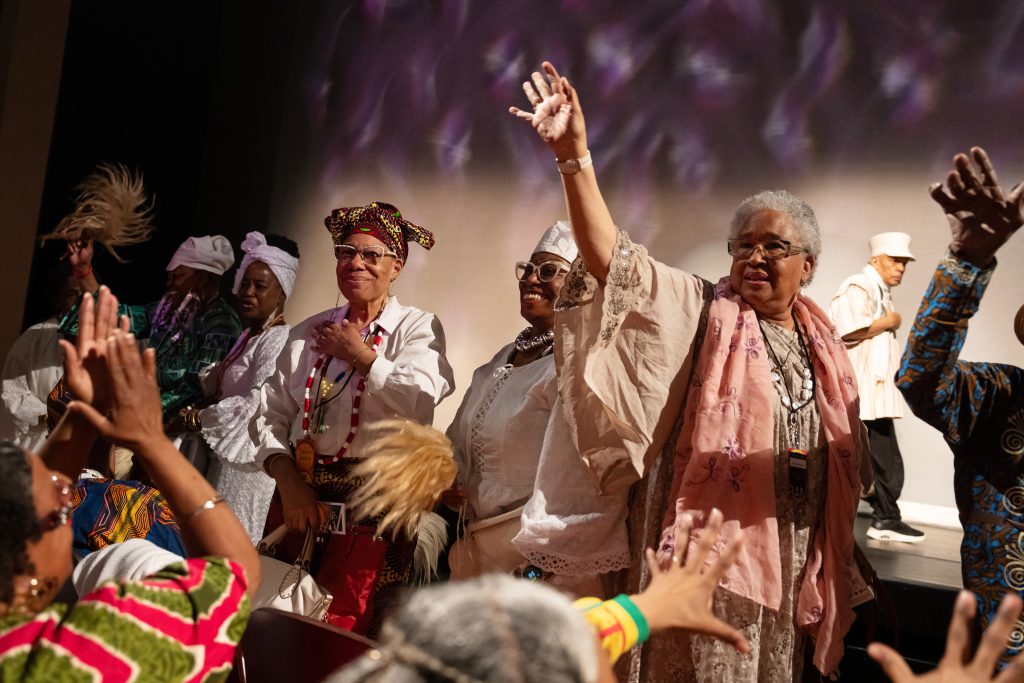
This group of twenty-eight elders hold the distinction of having been participants in the first DanceAfrica forty-nine years ago. Suddenly all three aisles in the orchestra are filled with the young dancers from The Billie’s Youth Arts Academy Dance Ensemble under the direction of Dr. Karen Thorton. Their participation brought this opening section to an energetic yet reverent conclusion.

The DanceAfrica Spirit Walkers, a division of Forces of Nature Dance Theatre, takes us on a new diasporic odyssey each year. In past years we had walked with AI generated elephants in grasslands of Mozambique or traveled down river to the Dja Faunal Reserve, a southeast Cameroon rainforest in Yaoundé and we partied at an Afrobeats club in Ghana. Each encounter reinforces the holistic connection between the earth, its inhabitants, the culture and the Gods.

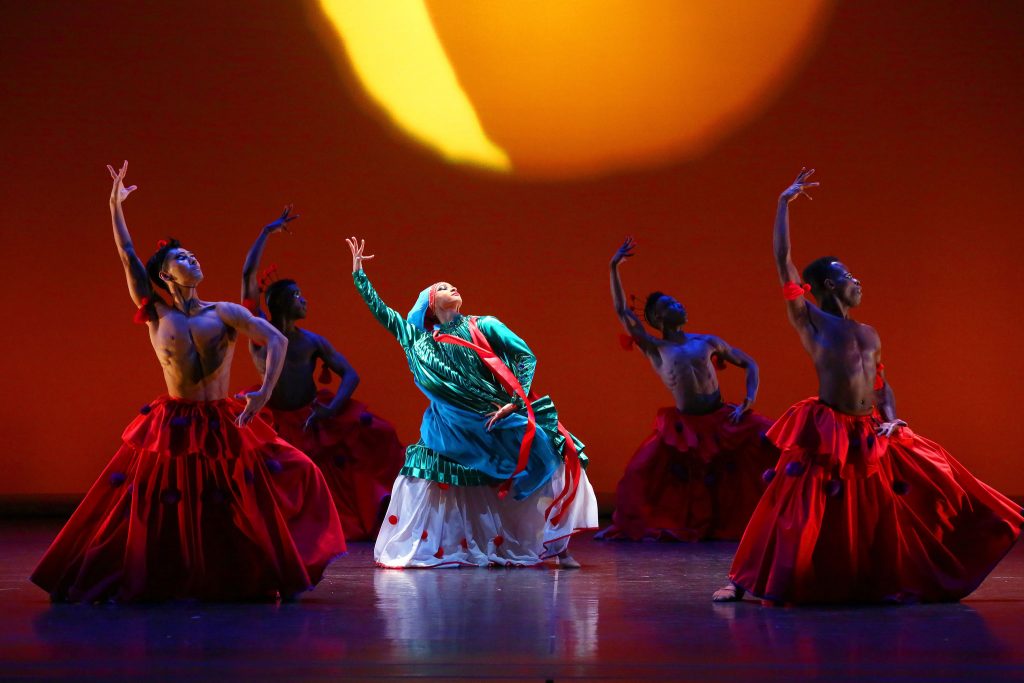
The high level of production elements including lighting, costumes, sets, music, choreography and staging remain bar none. His 2026 offering was no exception. This year we ventured to Uganda to experience Mami Wata… Nalubaale: In honor of She.  

We could paraphrase but, Baba Abdel best describes the production and deity as,  “Mami Wata… Nalubaale: In Honor Of She (Mother Water… Mother Of The Ancestral Guardian Spirits) honors and pays profound respect to the Great Mother and her divine elemental manifestation of water in the oceans, lakes rivers, and seas that help protect and guard the spirit of life and our Ancestors. Mami Wata is ever present in numerous myths and legends of Africa and its Diaspora, the Caribbean Islands, South, and Central America. Nalubaale, in the Lugandan language of Uganda, is the ancient traditional name of the largest freshwater lake in Africa and the second largest lake in the world.”
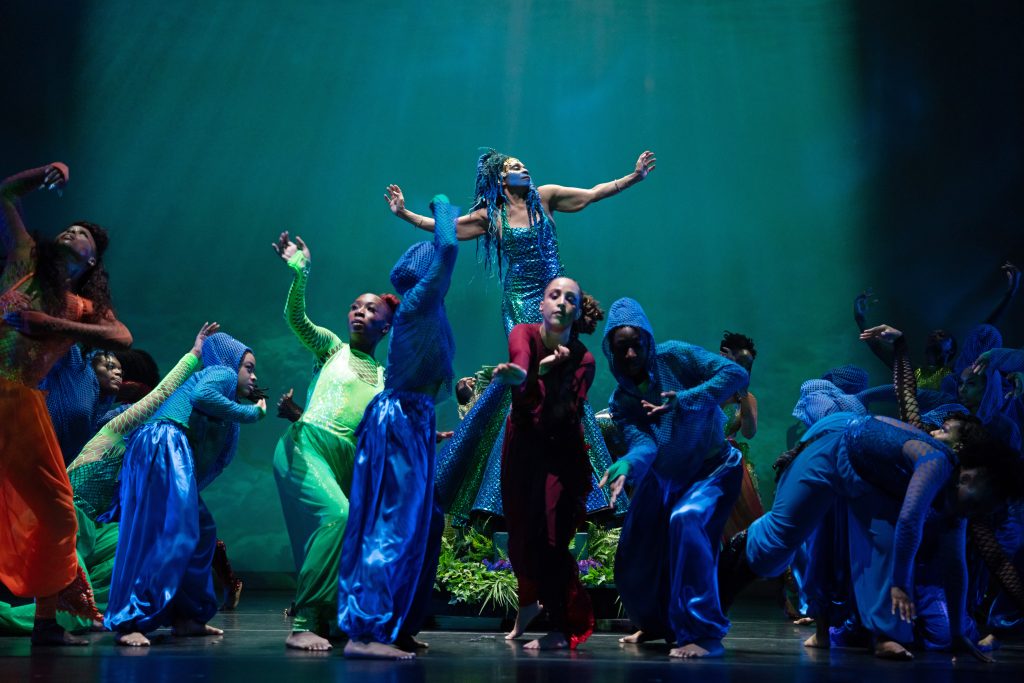
A single yellowish white orb upstage right appears as the sun above a billowing wave blue/green light. The illusion of being under water spilled over onto the orchestra, engulfing the audience in an atmospheric wave of magic. The dancers slow sustained upper body deportment produced an ethereal almost floating quality while a large corps of dancers consisting of member of Forces of Nature and the Billie Youth Arts Academy completed the expansive cast. The aquatic deity was eventually moved to center stage on a dais, which elevated her above the action. This gave the dramatically costumed and coiffed goddess an imposing omnipresent command.

In our O&A NYC Magazine 2025 DanceAfrica review (which we are sure you can all quote verbatim) we mentioned dispelling the monolith myth. This has become especially important in the present climate, when history is being rewritten to support a more sanitized narrative. 
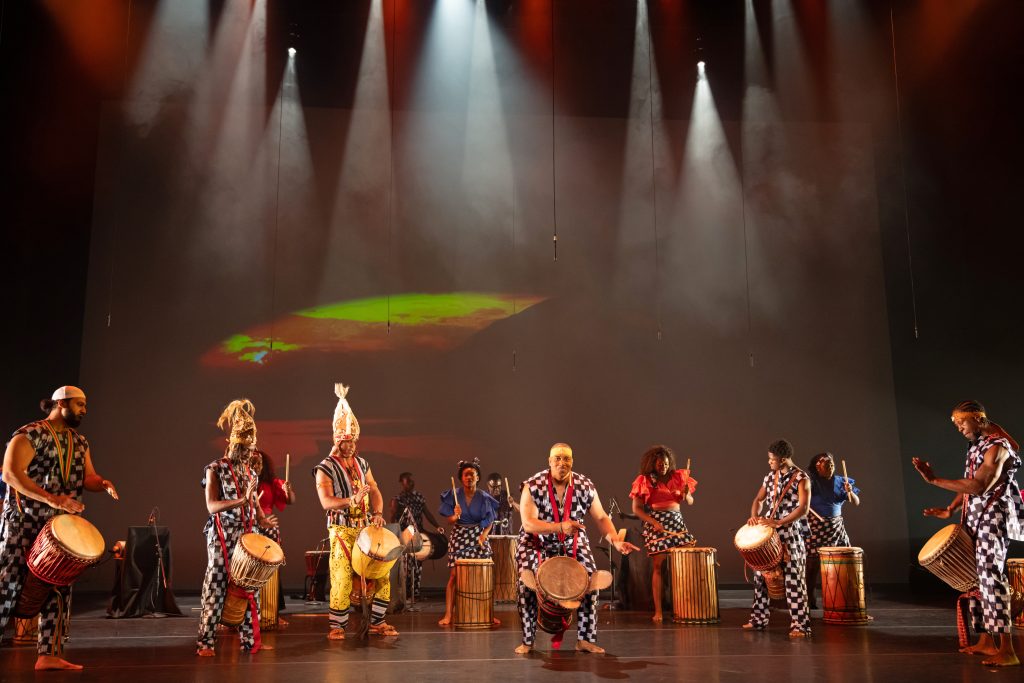
This year exemplified the majestic diversity of the African continent. The celebration presented Ugandan’s Ndere Troupe and Brooklyn’s own The Asase Yaa African American Dance Theater. Under the direction of Artistic Director Kofi Osei Williams (a first-generation Brooklynite of Ghanaian decent) his ensemble will soon celebrate their twenty-fifth anniversary of enriching the Brooklyn community with West African dance. This strong ensemble offered a program that included his company, youth from school and an impressive percussion ensemble lead by Williams. The section concluded with a rousing crescendo that incorporated the entire ensemble, musicians and students.

The Kampala based dance company, Ndere Troupe, prides itself on having over 40 authentic dances and countless songs in their repertoire. During DanceAfrica 49 they presented several works from different regions of the country. Throughout the presentation we marveled at the versatility of the men who danced, sang and played a myriad of instruments.
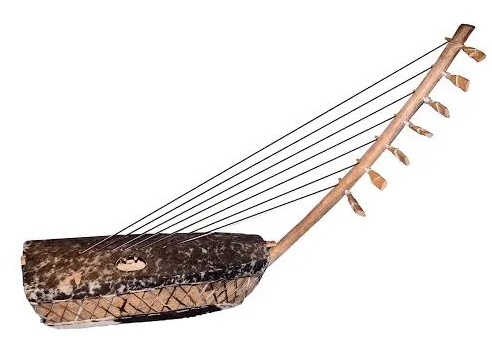
The instrumentation was one of the most notable differences between the West African Asase Yaa African American Dance Theater and East Africa’s Ndere Troupe. We were accustomed to the drum/percussion of West African dance; in contrast the sound of East Africa’s also incorporated the Embaire, A large wooden xylophone and string instruments including the Adungu. And the movement also had distinct differences.
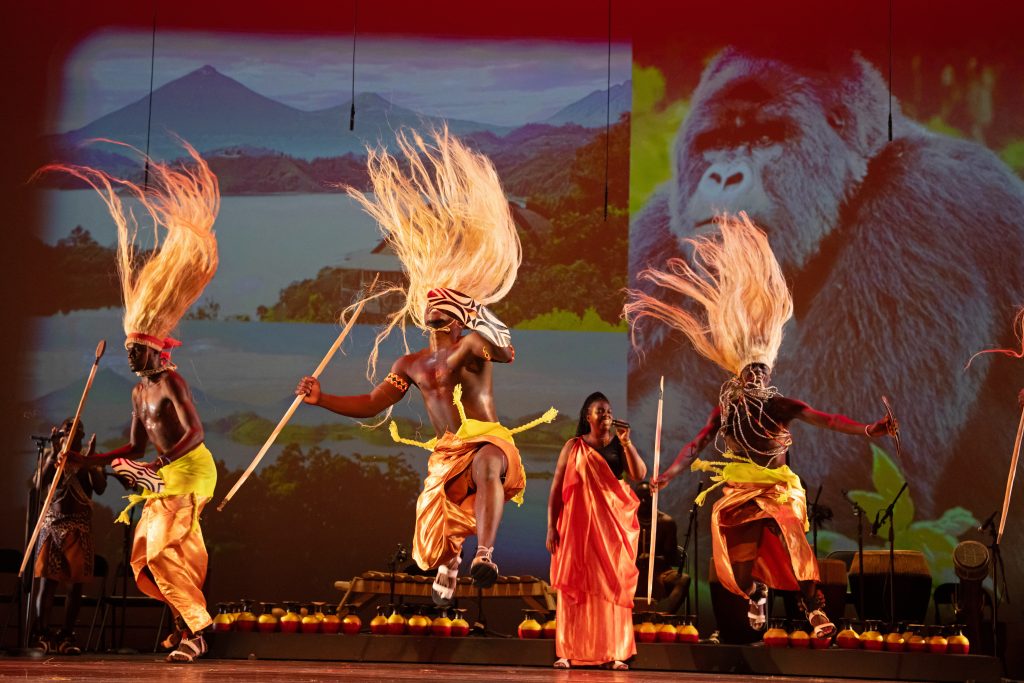
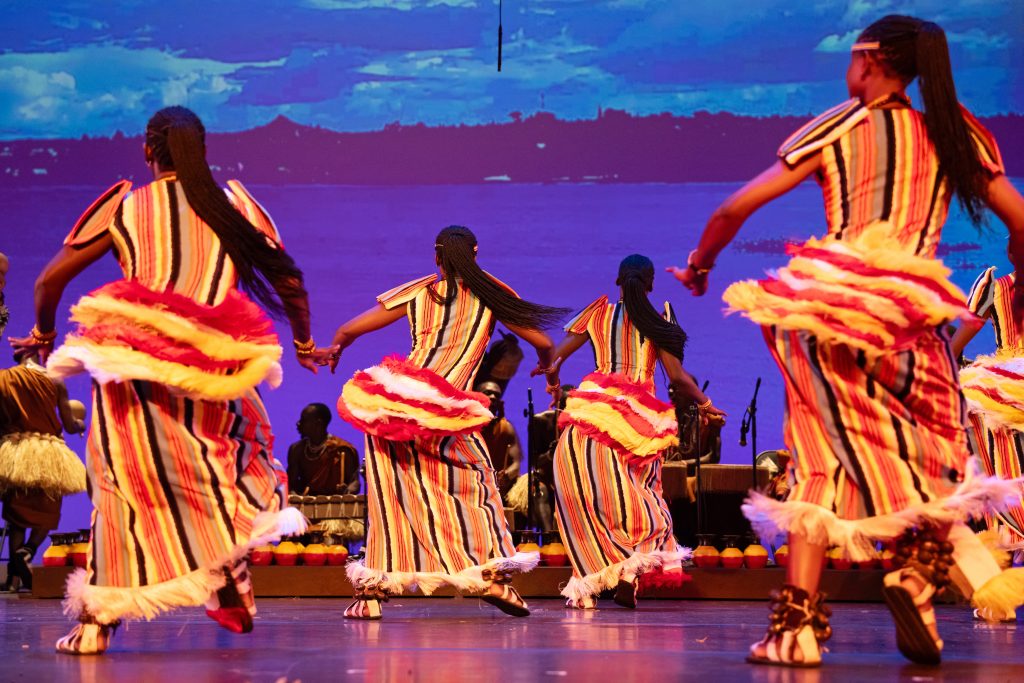
Two standout moments were the bakisimba and the kizino dance. The kizino, from the Southwestern region of Uganda, was an athletic dance performed by the men that consisting of sustained jumping – the original “hang time”. The bakisimba, which was performed by the women, originated from the Buganda Kingdom in Central Uganda. The deliberately calm use of the head, arms and torso in juxtaposition to the continuously circular moving hips is one of the truest examples of the use of polyrhythms. Members of the The Billie’s Youth Arts Academy Dance Ensemble were given the opportunity to learn and perform the bakisimba with the Uganda ensemble creating another Brooklyn Sankore moment.   
Through DanceAfrica, Kwanza at the Apollo and Forces of Nature Dance Company Abdel Salaam has enriched the community for over four decades. The focus has always gone beyond merely dancing, its dance as communication, dance as education, and dance as affirmation. Salaam’s gifts have been applauded and acknowledged, but in our opinion, he remains an under recognized artist.
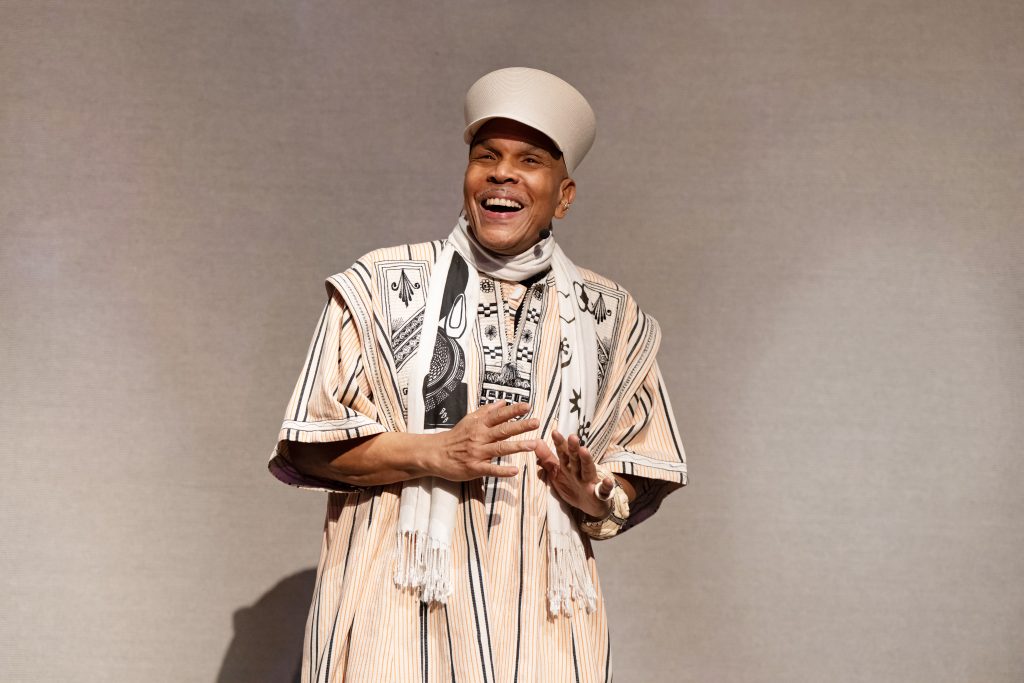
His production elements, strong choreography, imaginative concepts and uncluttered direction rival the best concert dance and theatrical productions. We must ask ourselves why isn’t his work being presented by more companies and outside organizations? Clearly their loss. Fortunate for us we can capture his magic in these productions, but we would all benefit from more Abdel Salaam.

DanceAfrica reminds us of the Lerner and Loewe musical Brigadoon. In the musical a magical village appears one day every hundred years creating an idyllic community. At DanceAfrica a magical African village appears for four days every May transforming BAM and the surrounding streets into Brooklyn’s Sankoré Madrasa.

In Photo: 1. Postcard of Sankoré Madrasa with the mosque in Timbuktu (1905–06), 2. Council of Elders, 3. Dyane Harvey Salaam and cast, 4.Asase Yaa African American Dance Theater, 5. the Adungu -string instrument, 6. kizino dance, 7.bakisimba dance, 8. Abdel Salaam

Photographer: 1. published by Edmond Fortier 2,3,4,6,7, 8 Julieta Cervantes

5/30/26 O&A NYC GOING BACK TO AFRICA WITH WALESTYLEZ: Davido – Amapiano

Nigerian Afrobeats Superstar Davido has dynamic ties to Amapiano, frequently collaborating with South African artists and infusing his music with the genre’s signature log drum baselines. While he doesn’t have a single solo song titled “Amapiano,” his catalog is rich with cross-continental Amapiano hits and remixes.

Continue reading

5/22/26 O&A NYC SHALL WE DANCE FRIDAY: Geoffrey Holder’s Dougla

The 2018 return of Geoffrey Holder’s masterwork Dougla to the repertoire Dance Theatre of Harlem (DTH) was a resounding success. The work is a sensorially sumptuous movement fest; and it is no wonder Dougla has remained an audience favorite since its premiere on April 16, 1974.

Continue reading

5/20/26 O&A NYC WALESTYLEZ DANCE PARTY: Dancehall All Stars vs Afro All Stars – Exhibition Battle

The Dancehall All Stars vs Afro All Stars Exhibition Battle took place on May 16, 2026, as one of the most highly anticipated highlights of the annual CDC Dance Festival in Berlin, Germany.This intense, high-energy clash marked the 3rd edition of the special exhibition match, serving as a direct cultural dialogue between Jamaican Dancehall culture and diverse African dance influences. Continue reading

3/10/26 O&A NYC DANCE BY WALTER RUTLEDGE: Ronald K. Brown/Evidence

By Walter Rutledge

Ronald K. Brown/Evidence presented their New York City season at the Joyce Theater February 24 through March 1, 2026. The company offered two programs, a total of eight works spanning the years 2006 through 2017. The production experienced some snow drama with the cancellation of the February 24 performance and the addition of an evening show on Sunday March 1st. The six-day, seven performance season paid tribute to Ibiwunmi Omotayo Olaiya and Toni Pierce-Sands.  Continue reading

3/4/26 O&A NYC DANCE BY WALTER RUTLEDGE: Remembering – Jamel Gaines Creative Outlet

By Walter Rutledge

Black History Month 2026, a month of reflection, remembrance and rejoicing the accomplishments of Americans of African descent, has come to an end. It was a month spent celebrating and remembering not only the sacrifices of the renowned such as Langston Hughes, Martin Luther King Jr. and Harriet Tubman, but of forgotten like Private Sandy Wills. Jamel Gaines Creative Outlet’s multi-media production of Remembering presented at the BAM Fisher Fishman Space on Friday, February 13 honored both the memorialized and the marginalized in an example of how art and education can dance arm in arm.   

The Friday evening production was the culmination of a week of daytime young audience performances offered to schools throughout the five boroughs. Gaines repurposes the production every year to bring awareness to more Black history facts. This Black historical enlightenment is often unexplored by mainstream academia. In so many instances it has been left up to the descendants of the forgotten to keep their memories alive. Gaines’ Remembering expands our understanding of the Diasporic role in the building of America.

An image appeared on the cyclorama piercing the darkness and immediately transported us to an African rainforest. Percussionist Abou Camara appeared from stage right with a drumming interlude that welcomed us into the space. He was soon joined by drummers Aliseni Bangoura, Jahi Smith, Jaziah Kefentse, Forest Holmes-Dodge.

The percussive overture quickly evolved into a drumming call and response with the audience. Drummers would create a series of rhythms that the audience would clap the passages back. During the school performances the audience responded enthusiastically. And to the drummers’ credit they were also able to bring out that engaged inner child during the Friday evening performance. 

Speaking of children, the next sections showcased the young performers from the Creative Outlet school. Dancers Summer, Makena, Ava P., Elleyana, Sabi, Callista, Harley, Makhotso, Nylah, Alyssa-Ivy, Zenai, Jamina, Julee, Yazarrah, Amia, Mela, Leila, Avery, Ava S., Sage, Asha, Jaccori, and Nina, Ja-nae under the tutelage of instructors Ryan Greenidge (African) and Jada Williams (Ballet) gave us an inspiring performance highlighting future possibilities.

Orator Gha’ il Rhodes Benjamin joined by fellow narrator Talu Green and drummer Camara in a rendition of Langston Hughes’ iconic 1926 Harlem Renaissance poem I, Too. Hughes wrote I, Too in direct response to Walt Whitman’s 1860 poem I Hear America Singing.

Hughes felt Whitman excluded the Black experience from the American narrative. The poem is also known as I, Too, Sing America, the poem serves as a powerful declaration of African American identity, resilience, and the inevitable end of segregation. Usually performed by a man, Benjamin’s interpretation became an unshakable matriarchal statement.

The backdrop now projected a field of cotton with a procession of dancers making an arduous crossing in single file.  A solo dancer, Michael Dickey, stops moving as the backdrop changes to a barren (leafless) tree. His impassioned solo brought the horrors of lynching centerstage. Dickey delivered both an emotional and technically strong performance; but it was the more nuanced and theatrical subtleties that deeply registered Gaines’ powerful message with the audience.

The effect of war on our mothers was the theme of Mothers of War. Keven Crawford and April Watson opened the large ensemble section with a lovingly paternal duet. Set to the music of Hans Zimmer with spoken word by Shirley Black Brown Coward Gaines cleverly constructed a dance theater scenario that projected protective maternal instinct with a strong mother, brother, sister energy. The section was a reflection on war seen through the lenses of angst, loss, and the inner strength of women. The dance concluded with Watson draping her skirt to hide Crawford as if shielding him from the world of war.

Mothers of War provided a fitting segway into Cherly Wills poignant yet triumphant multimedia story of Private Sandy Wills, her great, great, great grandfather. A civil war soldier forgotten by time and buried in an unmarked grave. Through persistence, exhausting research and family support she was able to locate his remains and give him a proper military burial.

Wills found time to eloquently present her family’s heartfelt legacy with young people during the daytime performances. The audiences were so moved by Wills journey that each performance ended with spontaneous applause. The truest barometer of how effective arts in education can be to imbue the next generation.  

Guest artist Thera Ward’s Friday evening performance was nothing short of mesmerizing. Ward embodied the narrative making it her own. Her interpretation exuded a presence and command that pulled the audience into Wills’ uplifting page of American history.

We The People was a sober and contemplative statement on unity. Choreographed as an ensemble movement the unison created a sense of camaraderie. Always a showman, Gaines took us out with an up-tempo bang. The finale displayed one of Gaines strong suits; his ability to bring together interdisciplinary dancers of varying levels of proficiency.  Every performer brought their A-game to a house music crescendo.

Gaines’ commitment to share the history and contributions of Americans of African descent extends beyond February. His aim is to share this vital part of American history with the world 365 days a year.  It is the goal of the Jamel Gaines Creative Outlet that we never forget – that we always keep Remembering.

2/13/26 O&A NYC DANCE BY WALTER RUTLEDGE: TV Personality Cheryl Wills Joins Remembering Cast.

By Walter Rutledge

Journalist and author Cheryl Wills joins the cast as both actor and playwright for the Jamel Gaines Creative Outlet Dance Company in tonight’s production of Remembering at the BAM Fisher Fishman Space, 321 Ashland Place, in downtown Brooklyn. Wills shared the story of her great, great, great grandfather Private Sandy Wills with young audiences on Wednesday and Thursday. On Friday evening’s performance playwright Wills will be performed by Thera Ward. Continue reading

2/11/26 O&A NYC DANCE BY WALTER RUTLEDGE: Thera Ward – A Dancer For All Seasons – Unity through Community

By Walter Rutledge

Thera Ward has had a varied performance career based on her ability to broaden her artistic horizons. At 13 she made her debut as one of Dance Theatre of Harlem (DTH) founder Arthur Mitchells’ Baby Ballerinas. By 17 she was touring the world performing principal roles with DTH and helping to crack ballet’s color glass ceiling. Continue reading

2/9/26 O&A NYC DANCE BY WALTER RUTLEDGE: Meet Deven Crawford – Unity Through Community

Meet Deven Crawford a 19-year-old Las Vegas Nevada native who is living his dream.  The former dance major at the Las Vegas Academy of the Arts happened to meet Jamel Gaines at the 2024 IABD (International Association of Black in Dance) conference. Today Crawford is a sophomore studying dance at Marymount College in Manhattan and one of the newest members of the Jamel Gaines Creative Outlet Dance Company (JGCO). Continue reading

1/30/26 O&A NYC DANCE BY WALTER RUTLEDGE: Unity Through Community – Jamel Gaines and MAAFA: The Capture

By Walter Rutledge

Dance Theatre of. Harlem founder Arthur Mitchell told me, “It’s easy to choreograph on professionals try choreographing on regular people”. He was implying that the dance maker must rely more on creativity than on established steps and patterns. Jamel Gaines has accepted this challenge. Instead of using members of the Jamel Gaines Creative Outlet Dance Theater, he has constructed a large intergenerational cast of church constituents.

On Sunday February 1st the Creative Outlet founder/artistic director will present his staging and choreography in MAAFA: The Capture. The Brainchild of Bishop, Dr. Johnny Ray Youngblood, the 9am free performance at Mt. Piscah Baptist Church, located at 167-10 137th Ave in Jamaica, Queens, will herald in Black History Month. MAAFA: The Capture is a twenty-minute dance theatre vignette depicting the African American experience.

O&A NYC Magazine Editor-in-Chief Walter Rutledge attended recent rehearsals and watched Gaines put his neophyte cast through the paces. These rehearsals were equal parts inspiration and perspiration. A true old school director Gaines rehearsals are both exacting and exhausting. And Gaines high energy and cajoling demeanor effortlessly brings out the movement shapes and dramatic artistry. Don’t take my word here’s a sneak peek into the rehearsal process.

MAAFA: The Capture rehearsal

 The black church has always been the source of not only inspiration but the hallmark for information and education. MAAFA: The Capture captures African American history in an entertaining and enlightening dance theater group endeavor. Unity through community.