
The Paul Taylor Dance Company‘s New York City season opened on Tuesday November 4 at the New York State Theater in Lincoln Center for 20 performances through November 23. The opening night performance presented Paul Taylor’s Concertiana and Cascade, and the New York premiere of Hope Boykin’s How Love Sounds. That evening Boykin’s work programmatically felt like a culinary intermezzo, a refreshing palette cleanser between two Taylor classics; but on Thursday’s program How Love Sounds proved to also be a versatile audience pleasing closer.
The eclectic music score took us from the late 1800’s romantic period to the 1970’s disco era. In the program notes Boykin described her music selections, “These very particular selections and songs have long been sitting close to me, my heart …”. Indeed, her choices felt like they had been derived by flipping through a stack of ole vinyl favorites.

The curtain rose in silence on four couples sequestered in a large circular pool of light. As the music began the couples slow danced a Boykin style waltz to Antonín Dvořák’s Nocturne in B major, Op. 40. In a very visually satisfying moment, the couples moved in a circular pattern around a center couple which produced a carousel like effect.
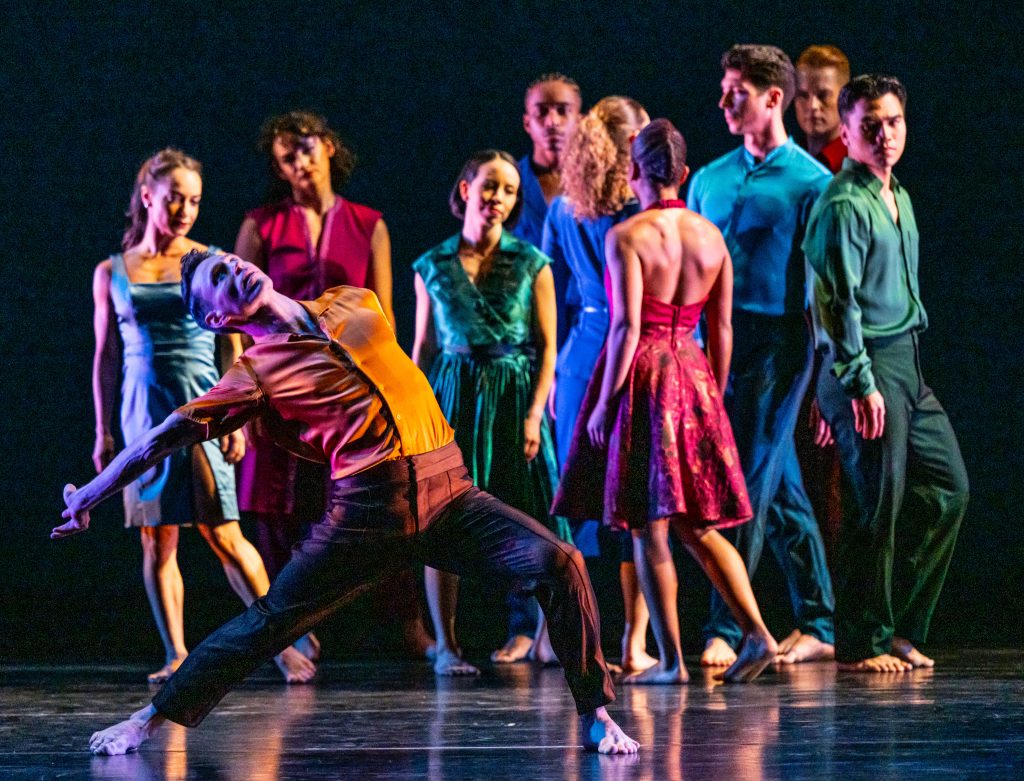
Boykin’s abstract dance theater narrative developed into a series of unrelated vignettes each with a common theme of love. And with a seamless transition from the opening section John Harnage performed a solo set to Patsy Cline. Harnage interpretated the isolation and aloneness with a stoic inner reserve.
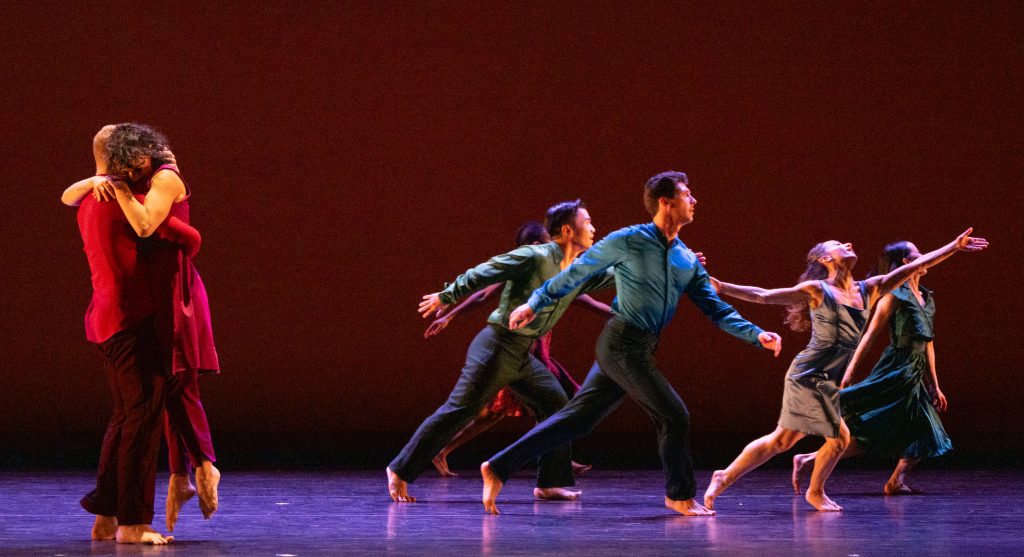
Emmy Wildermuth and Lee Duveneck performed their duet mostly apart. With the ensemble moving center stage the dancers were divided leaving one on stage right quarter and the other stage left quarter. The space/distance created the illusion of an unrequited love. The section ends with the couple finally consummating their relationship with an embrace center stage.
The work was punctuated with three movement statements set to proses written and performed by Boykin. Her melodious A cappella orations provided the soliloquies with a soothing rhythmic cadence that buoyed the confident yet introspective movement. Since all art is autobiographical these solos may be an insight into the choreographer’s own psyche.

The duet set to Stevie Wonder displayed a mature playfulness that suggested more familiarity than whimsey. Role defining solo passages were intertwined with seemingly omniscient physical encounters making the liaison even more alluring. Kudos to Jada Pearman and Devin Louis who captured Boykin’s fresh and unencumbered approach in the work’s strongest example of the abstract narrative/storytelling genre.
How Love Sounds culminated with Donna Summer’s disco anthem I Feel Love. The ensemble movement began with a cool minimalist feel, a restraint that Boykin had effectively used throughout to the work’s advantage. When the dance reached a crescendo Boykin inserted a bow (false ending) which cleverly created a series of built in curtain calls. The audience showed their approval by sustained clapping in sync with the 135-bpm disco downbeat.
How Love Sounds is a fun well crafted dance that demonstrates the company’s versatility, and it continued choreographic exploration. If you missed the November 4 and 6 performances of How Love Sounds, you still have one more chance to catch the work on Saturday, November 15 at 8pm. For more information about the Paul Taylor New York season and/or purchase tickets visit https://paultaylordance.org/performances/newyorkseason/
In Photo: 1. Cast 2. John Harnage and Cast 3. Emmy Wildermuth and Lee Duveneck with Cast 4. Jada Pearman and Devin Louis 5. Cover photo. cast
Photography by 1 & 2. Hope Boykin 3 & 4. Steven Pisano Cover Photo. Hisae Alhara